
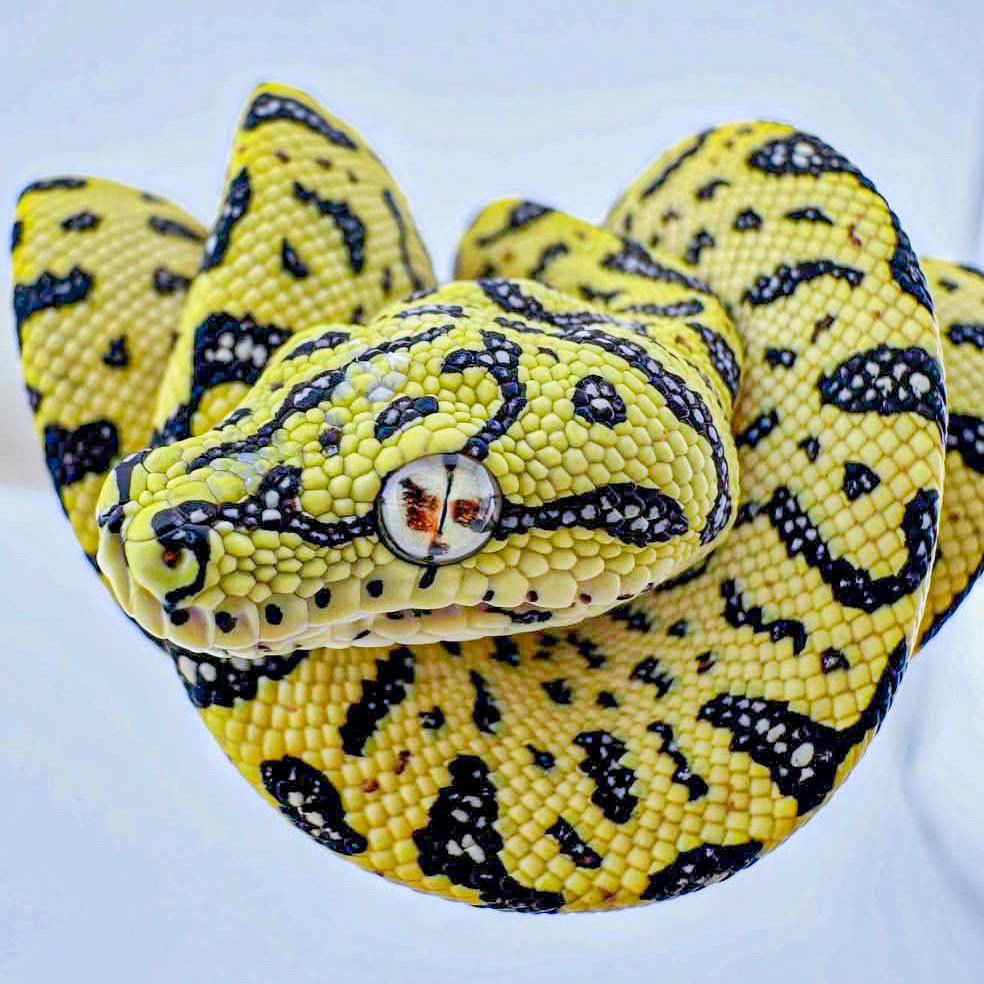

TC.25.07- 75% Carpondro HOLDBACK
Resembling a Manokwari/Aru yellow neonate at first glance, this individual features deeper, darker and a high abundance of freckled patterning with high black-and-yellow contrast and striking white pattern interiors. It has brighter whites than many of the others. Based on past projects, these whites may transition to blue with age. Feeding confidently, though occasionally selective, this individual has a white/blue tail tip and shows intriguing ontogenetic color-change potential. Its head stamp is also very sporadic, and the pattern is much more broken and random. This one will be Retained as a hold back.
Sire: Ozzy — Manokwari Green Tree Python (Morelia azurea pulcher)
X
Dam: Tigra — 50/50 Carpondro (Morelia azurea pulcher × Morelia spilota cheynei)
TC.25.07
75% GTP/25% carpet python-Carpondros should be cared for, similar to how Green Tree Pythons are cared for. Carpet pythons possess a larger and more diverse natural habitat than do GTPs, with varying conditions inhabiting the Southern regions of Papua New Guinea and much of the Northern, Eastern, and Southeastern regions of Australia. GTPs inhabit Papua New Guinea, some of the surrounding islands, and only a small part of the upper northeastern Cape York peninsula of Australia.
It is possible that 75% Carpondros may be able to handle a broader range of temperatures and humidity levels than pure GTPs. I currently treat their care the same as GTPs. Higher temperatures and even lower humidity could be considered for future husbandry and habitat requirements as the animal matures. However, use discretion when the snake sheds, ensuring it’s always in one piece. If sheds are spotty and not in one piece, that can be an indicator of dehydration, low humidity, and/or too hot of temperatures.
All hybrid neonates are established in shoebox-sized tubs in a snake rack with a hot side ranging from 80-87°F. The key to their care is constant monitoring. I monitor the direct temperatures with a digital thermostat and observe where the snake spends most of their time. If the snake is only perched on the cool side, I usually lower the heat by a degree or two until the snake spends more time on the hot side. Additionally, paying attention to the snake's body language can indicate that it is comfortable. Loose wrapping around the perch or excessive movement throughout the cage can be an indicator the snake is too hot. Monitoring the snake's body language and behavior, combined with minor adjustments to environmental temperatures, are key factors in ensuring these hybrids' success.
Paper towels are kept as substrate, with a small 3" ceramic water bowl and two horizontal perches. The perches are made from plastic PVC tubing and positioned on the upper section of each cage. Ensure the perches are around the same circumference as the snake's body at its thickest portion. I spray neonates daily to ensure freshwater droplets are available on the walls and the snake's body, helping it stay hydrated and boosting humidity. I often see them drinking straight from their coils or a slow drip from a spray bottle.
Carpondros are being offered food weekly, consisting of F/T (frozen/thawed) pinky or fuzzy mice roughly the same girth as the thickest part of the snake’s body. It is important not to strain the bowels of GTPs and potentially Carpondros. Avoid large meals to reduce the risk of prolapse. 75% Carpondros may be able to handle larger meals compared to adult GTPs when they are older, but they should be offered smaller meals as they are young.
DISCLAIMER: As with any snake species, mutations can happen. Hybridization and the breeding of hybrids has its risk. The main danger includes infertility in male counterparts, so all Carpondros should be firstly considered as pets before as potential breeders. Unless otherwise indicated, Tree Gems guarantees healthy and thriving individuals free from any visible or noticeable abnormalities or mutations before sale.
**Hybridization has its risks, as with any breeding undertaking. Considering these are some of the first 75% Carpondros in the US. We are excited to see how they will be established as adults. I anticipate them being excellent pets, with a likely chance that both the male and the female will be fertile and able to produce a new F3 lineage with striking patterns. From my experience, Carpondros make very hardy snakes, even more resilient than pure Green Tree Pythons. For example, Carpondros may handle larger meals, tolerate handling, and permit wider environmental conditions better than pure GTP's. ** Nevertheless, I have noticed that Carpondros have impressive behavioral characteristics that indicate they will thrive in captivity and even make "domesticated lineages".
When handling young and fragile snakes, especially neonate Green Tree Pythons (GTPs), it’s important to exercise great caution. Their spines are delicate, and their muscles are stronger than their ribs, so forced movement, thrashing, or restraint can lead to injury. Due to these concerns, I handle 75/25 Carpondro neonates sparingly. When I do, it’s usually because they have voluntarily left their perch, which often happens when disturbed.
From my experience, these hybrids are notably more curious and less skittish than typical pure GTPs, making them easier to handle. While Carpet Pythons are more active than GTPs, Carpondros seem to have a balanced behavior. They may sometimes slither around when handled, exploring their surroundings. Other times, they anchor themselves onto a finger or article of clothing and curiously observe their environment.
Ontogenetic coloration change refers to the natural color transformation that occurs as a reptile matures from a juvenile to an adult. In new hybrid Green Tree Python lineages, particularly the 75% Carpondro hybrids, this change is especially intriguing. Since hybridization of these pythons has only gained popularity in the past decade, there are very few adult specimens, making it difficult to predict how their coloration will evolve over time.
This uncertainty adds an element of excitement and mystery to owning these unique animals. As they grow and develop, their colors may shift in unexpected ways, offering a captivating experience for reptile enthusiasts. Investing in these hybrids is not just about owning a beautiful snake but also about being part of an evolving project where each animal's appearance continues to surprise and delight as it matures.
